

Why Should Big Businesses Be the Only Ones With This Advantage?

A few days ago I had a full a-ha moment while sitting on the floor with my son, half-answering an email, half-getting ready for the day.
Couldn't even tell you where it came from but it sparked an entire blog post and possibly a series in a matter of minutes. I talked through the whole thing in my phone notes while he cheezed at me on the floor.
If you're a small business owner with a website, keep reading—you'll walk away with at least one thing you can do this week that big businesses pay entire teams to figure out. Here. We. Go.
a very quick back story
I was still working in the corporate world at the time but had been thinking about leaving to work for myself. I had been praying about ways that I could serve people in a way that felt more meaningful–especially if that time was going to be spent away from my daughter. I freelanced for several years prior and loved working with small businesses but taking it full time was risky.
So when I literally stumbled onto a small business I had not noticed before while leaving church, I took it as the sign I had been asking for. I heard music blasting, saw an ‘open’ sign on the sidewalk outside of what looked like a home, and dragged my family (ignoring our usual rush home for lunch and nap). In we went! The owner mentioned she was looking for a designer. I gawked over at my husband like: 👀 ARE. YOU. KIDDING. ME. He laughed. (I'm allll about the signs if you can't tell.)
We exchanged cards. A few days later we got on a call and I'm not gonna lie… I was JAZZED. I could see SO many places on her website that weren't working. Simple fixes that could potentially ripple into big results. I started talking. And I used the words user experience a few times.
She cut me off…
"I don't think this is going to work. You're way too corporate. You don't understand me or my business."
Aaaand that was that.
It stung. Mostly because I knew exactly how to help her. I realized immediately after the fact that I had just come off like an alien in how I was talking about it. She wasn't wrong. User Experience really is its own world—a whole profession with its own language. When you're in it, it's just how everyone talks. Outside of that world it comes off very differently.
Lesson learned.
I decided I wouldn’t even say it. I would just lead with ‘graphic design’, bring my user experience background into every project quietly, and wouldn’t go into too much depth with clients on what I'm doing behind the scenes.
That rule has stuck with me for several years. But (after some serious noodling) I'm throwing it out the window because I want to actually write valuable content and help people if I’m going to put the energy into a blog and ask people to spend their precious time reading it. I don't think anyone needs another design article telling you “your business needs to be on brand" if you know what I mean.
Ok, so… what even is user experience?
Even typing that, I can feel myself making an EEEK face. But stay with me—it’s simpler than it sounds and WAY more relevant to your entire business than you might think.
User experience design (or UX) is something most small business owners have never heard of. Here's what it actually means… understanding exactly how a person thinks, feels, and moves through an interaction with your business. Your website. Your booking process. Your first email. The way someone finds you, contacts you, and decides whether to trust you enough to pay you.
It affects your website, your processes, how you attract your target market—basically EVERY part of how someone experiences your business before they ever become a client. Does this make sense? Does it feel like it was made for the exact person I'm trying to reach? And if the answer is no—then figuring out WHY and fixing it.
To be clear, none of this is about aesthetics. A beautiful website can still be a confusing one. UX is about how things work, not how they look.
That's it. That's the whole thing.
Following?
Big businesses have entire teams for this. Small businesses don't even know it exists.
When I was in the corporate world, I sat on a UX team of about 50 people. Fifty. Those businesses weren't spending that kind of money because it felt nice—they were doing it because it works. Improved UX has been shown to dramatically increase conversions (like turning someone just browsing your site into an actual inquiry) and reduce drop-off (when people just straight-up leave your site all together). In my opinion, it's one of the most powerful ways of thinking in business today.
And here's the reality for small businesses specifically: your potential clients have Google literally in their hands at ALL times. If something on your site isn't working, isn't clear, or just feels slightly off— they're not emailing you to let you know. They're clicking out of your site and finding someone or something else to solve their problems. In seconds. That's not an exaggeration, that's just how it works now.
No offense to the big guys… but small businesses mean so much to me because of the people behind them. And there’s a big gap that this kind of thinking only lives in/for giant corporations when the people who need it most don't even know it exists.
For some perspective…
I spent an entire YEAR on one page of a website for a financial services company. A single page. 40+ hours a week for more than a year. A page with only a handful of actions on it—but that page had the potential for someone to decide whether to stay or move their money somewhere else. Now, one person doing that was not a big deal. But when you're looking at patterns across thousands of people having a similarly confusing experience? In large numbers that was potentially hundreds of millions of dollars walking out the door. One moment of confusion, multiplied across enough people, adds up fast. The company knew it. That's why they had a team like mine designing and running research studies with real people, testing every single interaction on that page, for an entire year.
Now, you're probably not managing hundreds of millions (Dr. Evil pinky and all) in assets. But you are managing something just as important to you… your business, your clients, your livelihood. And every person who visits your site and doesn't inquire… every inquiry that never comes—that matters. Maybe even more, because for you, every single one counts.
Why should big businesses be the only ones who get this insanely important advantage?
Why I care about this so much
Every person I've ever worked with is extremely empathetic, creative, and personal. I see that spark when they talk about what they do. It gives me goosebumps. That instinct… to really care about who they're serving—is already there. They just don't have the framework to channel it into every part of the experience they're creating.
That's exactly what UX thinking does.
During my deep dive at the start of every project, I ask: if money were no object, what would you be doing? And the vast majority smile and say they'd be right where they are. (There have been a few "fishing" responses, I'm not gonna lie. Not 100% but still.) These are people doing what fires them up, serving others—and also loving what it allows them to have. The freedom to be creative. No red tape. Never having to choose between work and their kid's school event. Something that finally belongs to them. (The impromptu family beach trip mid-week when a presentation gets moved 🙋♀️.)
What I’m trying to say is that it's a lot of love. A lot of risk too…but a lot of love, and a lot of reward. And I want their businesses to be as successful as possible so that they can keep going.
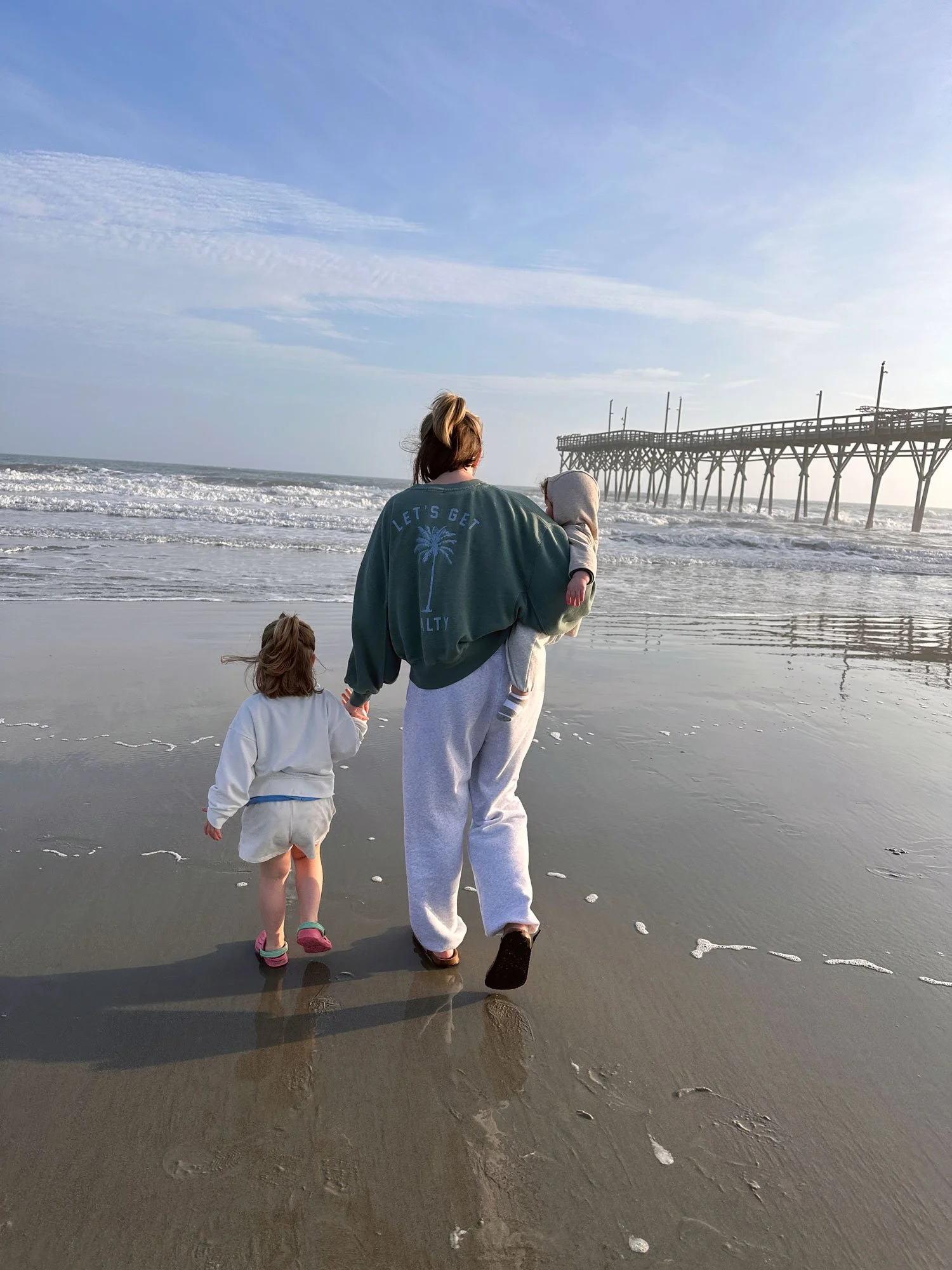
Last week when a presentation reschedule turned into an impromptu mid-week beach trip. Still chilly in NC but that didn’t matter. This is what it’s all about [for my fam].
are you ready?!?!?
Your first UX research study (!!!)
The thing about UX research—it sounds like it requires a team and a budget. It doesn't. The most useful version is almost embarrassingly simple. And it will tell you more about your website in one afternoon than any analytics tool ever could.
And before you say "but my site is getting inquiries"… I still recommend doing this. Because for every person who inquired, there were likely people who didn't make it that far. People who might have been a perfect fit, who you'll never know existed, because something in the experience sent them elsewhere. Even if things are working, this will show you what is and why—and that alone is worth it.
One more thing I have to get off my chest before you start: stop asking machines and robots what to do with your website if you're trying to serve humans. Ask the humans. The answers you need come from real people interacting with your real business—not a machine guessing what they might think. This is exactly what the research study is for.
OK, here we go
We’re going to start with the basics. Walk through your own website like you've never seen it before.
Except—you actually can't. It literally CANNOT be you. You know too much. You built it, you wrote it, you've stared at it wondering if the font is right. You are the worst possible person to evaluate your own website… and that's not a bad thing, it's just how it works.
Step 1: Find your person
Someone who doesn't know your business. A friend, neighbor, or family member. Doesn't need to be your ideal client—just someone who has genuinely never been to your site.
Step 2: Give them one task
Not "look around and tell me what you think.” That’s too open. Give them something real and applicable: "find out how to book a call with me" or "figure out what I charge." One task. Simple.
Step 3: Sit back and don’t say anything
This is the hard part. Watch where they pause, scroll back, click the wrong thing, or give up. EVERY one of those moments is information. Do not help them. Just watch.
Step 4: Ask a few questions after
What felt confusing? What couldn't you find? What would have made you leave? Their answers will probably be simple… and slightly humbling. That's what you want.
Step 5: Repeat with 5–10 people
This is where the GOLD is. One person's confusion might be a little quirk. Five people hitting the same wall? That’s a problem worth fixing. You'll leave with a short list of changes that have nothing to do with aesthetics and everything to do with whether your site is actually working.
EEEE Ok, go have fun! I’m legitimately excited for you.
OH! And definitely send people a little gift card for coffee after. They just gave you real, unfiltered feedback that may make or break your next big client. Treat them like research participants, because that's exactly what they are. 😉
Can't do it in person? Here are your options
Remote: Record a video call and ask them to share their screen. Watch it back—you'll likely catch things in the replay you missed live.
No one in your circle? Post in a Facebook group or community and offer a small gift card. People will say yes.
Short on time? Once with one person beats zero. Start there. doing it with one person may even spark a list of questions you didn’t think of the first time after watching someone do it. And this could really help you prep for a larger group in the future. For example, UX is so foreign to my husband so I’m going to ask him to read this blog to make sure it’s * hopefully * in simple enough terms to actually be valuable and effective for you. Ideally, I would want more eyes on it but I’m like this seciton opens with: short on time.
One last thing. This is barely scratching the surface. There is SO much more to UX than one blog post could ever cover. We’re just getting started. ✌️
Alrighty
For several years I've been doing this work as much as I could quietly, worried I'd scare off my people. That phone call ended up being a big sign but not in the way I thought or gave it credit for at the time.
Anyway. Here we are. 😄
If something here resonated—I'd love to hear from you. And if it freaked you out and you're not sure how you got to the end of this, tell me that too. Part of UX is trying things, seeing how they go, and trying again. I'm determined to figure out how to share UX thinking with small business owners in a way that actually lands.
I hope this finds the right people. You deserve every advantage working in your favor.
-Mel
Stay connected
If this made you go "wait, do I have that problem?"… good! That's the whole point.
Sign up for the newsletter to get more of this right to your inbox.